
Monkey Behavior, Science & Research
How Monkeys Learn New Skills
How monkeys learn new skills is a question that starts in infancy: monkeys are not born knowing how to crack a nut, use a tool or navigate a complex social hierarchy. Much of this knowledge is built through observation, practice and social learning over the course of years.
Learning by Watching
Young monkeys spend enormous amounts of time simply observing older, more experienced troop members. This observational learning allows skills like efficient foraging techniques or tool use to spread through a group and be passed down across generations, effectively forming a basic culture.
Trial and Error
Play is a critical part of skill development. Juvenile monkeys wrestle, chase and manipulate objects in ways that closely mirror adult behaviors like fighting, foraging and tool handling, allowing them to practice movements and problem-solving in a low-stakes environment before they matter for survival.
Group living provides constant feedback. A young monkey that approaches a dominant individual incorrectly, or fails to share food appropriately, quickly learns the social consequences. Over time, this feedback shapes behavior as effectively as direct instruction.
Tool Use as a Learned Skill
Some of the clearest evidence of skill learning comes from tool-using populations, such as capuchin monkeys that use stone hammers to crack nuts. These skills are not instinctive; young capuchins can take several years of practice to reach adult proficiency, refining their technique through repeated attempts and by watching skilled adults.
Why This Matters for Captive Monkeys
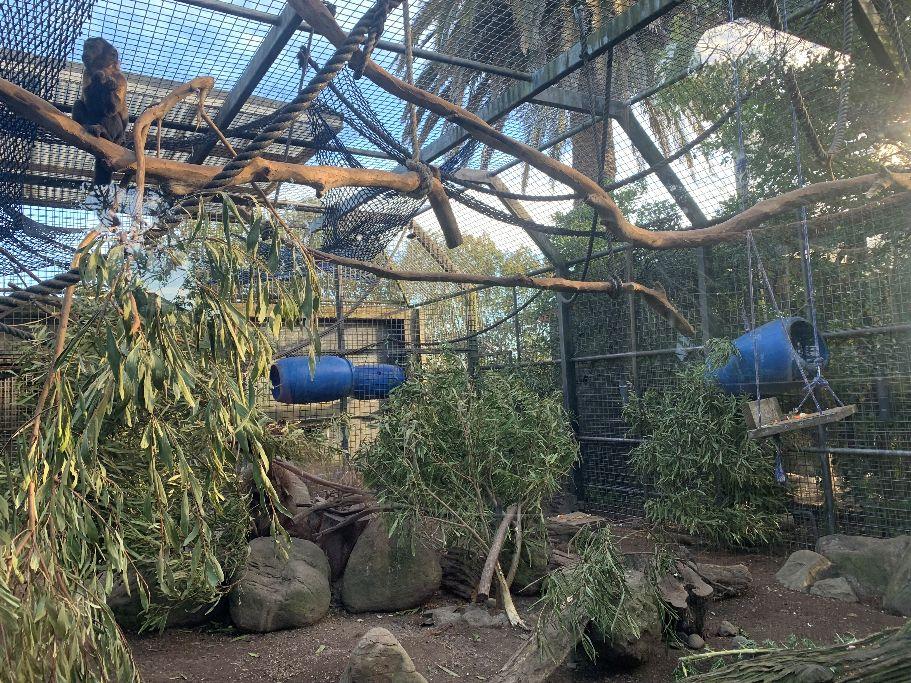
Understanding how monkeys learn is directly relevant to enrichment in captive settings. Providing opportunities for problem-solving, exploration and appropriate social interaction supports the same learning processes that would occur naturally in the wild, which is a key part of good welfare for any primate in human care.
How Monkeys Learn New Skills From Each Other
Researchers studying how monkeys learn new skills have found that social learning is often more efficient than trial and error alone. Young monkeys pay close attention to skilled adults, and troops with more experienced tool-users tend to pass those techniques down faster, a process closely related to how monkeys use tools like stone hammers and probes in the wild.
Frequently Asked Questions About How Monkeys Learn New Skills
At what age do monkeys start learning new skills?
Monkeys begin learning new skills in infancy, mostly through observation, and continue refining techniques like tool use well into juvenile development, sometimes taking several years to reach adult proficiency.
Do all monkey species learn new skills the same way?
No. How monkeys learn new skills varies by species; some rely heavily on social learning and observation, while others depend more on individual trial and error, depending on their social structure and ecology.
Why does understanding how monkeys learn new skills matter for captive care?
Understanding how monkeys learn new skills helps caregivers design enrichment activities, such as puzzle feeders, that support natural problem-solving and learning processes, according to guidance from the Association of Zoos and Aquariums.
Signs a Monkey Is Learning a New Skill
Caregivers and researchers watching how monkeys learn new skills often look for a few telltale signs: repeated, deliberate practice of the same motion, close visual attention to a skilled adult or peer, and gradual improvement in efficiency over days or weeks rather than instant success. Frustration and abandoned attempts are normal parts of the process, not signs of failure, and are part of why patience and repeated opportunity matter so much when monkeys learn new skills, whether in the wild or in a well-designed captive environment.
Taken together, these behaviors show just how much intelligence and patience go into how monkeys learn new skills over a lifetime.
