
Monkey Facts & Species, Primates Care And Tips
How Monkeys Sleep: Sites, Postures and Safety
Aug
Sleep is the most dangerous part of a monkey day. An animal that spends daylight scanning for eagles and cats has to spend eleven or twelve hours unconscious somewhere, and the choice of where to do that is one of the most consequential decisions it makes. Monkeys solve the problem with site selection, posture, huddling and numbers rather than with shelter, because unlike great apes they do not build nests.
Choosing a Sleeping Site
Most monkeys use tall trees with a dense crown, entering late in the afternoon and settling before dark. The preferred branches are often high and relatively thin, because a heavy predator moving along them creates vibration that wakes the group. Emergent trees that stand above the canopy, trees with smooth trunks that are hard to climb, and trees surrounded by open space all appear disproportionately in sleeping site data. Baboons and geladas take a different route and sleep on cliff ledges, where the drop itself does the work of a wall. Sleeping sites are reused for years and are as much a part of a home range as feeding trees, a point that matters in monkey habitats explained and monkey movement patterns.
Why They Sit Instead of Lying Down
Old World monkeys sleep sitting up, and they can do it comfortably because of ischial callosities, tough hairless pads of thickened skin over the sitting bones. The posture is stable on a branch, needs no platform, and allows a fast escape. Many New World monkeys curl into a ball on a fork or a tangle of vines, and prehensile-tailed species anchor the tail while they sleep. No monkey builds the folded-branch nest that chimpanzees and orangutans construct each evening, one of the more practical differences in monkeys versus apes.
Huddling, Warmth and Company
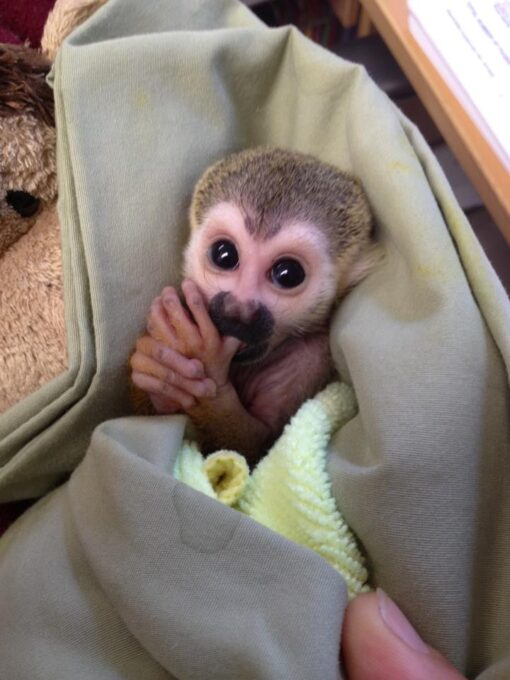
Sleeping in contact solves two problems at once. It reduces heat loss, which matters enormously for small species with a large surface area relative to their volume, and it means several pairs of ears are listening. Marmosets and tamarins pile into tree holes and dense vine tangles as a family unit. Japanese macaques form tight sleeping clusters in winter, and huddle composition follows the grooming network rather than chance. Infants sleep against the mother chest for months, a detail covered in baby monkeys.
The Night Shift
Owl monkeys invert the whole pattern. They sleep by day in tree hollows, vine tangles and dense epiphytes, then feed at night with enormous eyes adapted to low light. Their sleep sites need to be concealed rather than merely difficult to reach, because their predators hunt in daylight. The full story is in nocturnal monkeys.
How Much Do Monkeys Sleep?
Recorded sleep in monkeys generally falls between nine and twelve hours a day, with the higher figures in smaller species. Sleep architecture resembles ours in outline, with cycles of deeper sleep and periods of rapid eye movement sleep, and laboratory work on macaques has been central to understanding memory consolidation during sleep. Wild monkeys also nap: midday rest bouts in the shade are standard in hot climates, and in leaf-eating species long resting periods are part of the digestive strategy described in monkey diet by species.
Threats in the Dark
Nocturnal predators are the reason all of this matters. Leopards, ocelots, large snakes, owls and, historically, now-extinct big cats all take sleeping monkeys, and the alarm calls given at night are among the most intense in a monkey repertoire. Sleeping high and in numbers is the primary defence, as described in monkey predators and how monkeys protect themselves.
Sleep in Captivity
Captive monkeys need what wild ones choose: height, a stable perch or platform wide enough to sit on, a sense of enclosure on at least one side, and darkness. Bright night lighting, low perches, cold draughts and noise all disrupt sleep, and chronically poor sleep shows up as irritability, over-grooming and reduced appetite. Practical guidance is in the enclosure guide and seasonal care tips.
Frequently Asked Questions
Do monkeys sleep in nests?
No. Nest building is an ape behaviour. Monkeys sleep on branches, in tree holes or on cliff ledges without constructing anything.
Do monkeys sleep standing up?
They sleep sitting upright, supported by tough pads over the sitting bones in Old World species, or curled on a branch fork in many New World species.
Where do monkeys sleep in the rain?
Under dense crowns, in tree holes, against trunks or huddled together. Some simply sit it out and get wet.
Do monkeys dream?
They show rapid eye movement sleep, the stage associated with dreaming in humans, so it is likely, though nobody can confirm the content.
Read next: why monkeys groom each other and monkey senses.
Further reading
Explore More
- Homepage
- Shop
- Health Guarantee
- Shipping
- Contact Us
- Is It Legal to Own a Monkey?
- Baby Chimpanzees (Product Category)
- Macaque Monkeys (Product Category)
- Related: Top Monkey Questions Answered
- Related: Weird and Wonderful Monkey Facts
- Related: Incredible Monkey Photos and Stories
- New Article: Monkey Migration and Movement Patterns
- New Article: Monkey Senses

Pingback: Ultimate Guide to Monkeys: Species, Behaviour & Facts