
Monkey Facts & Species, Primates Care And Tips
The Fastest Monkey Species: Speed on the Ground and in the Trees
Aug
Speed means two different things in the primate world. On open ground it means outrunning a predator in a straight line, and one monkey does that better than any other primate alive. In the canopy it means covering distance through a three-dimensional maze of branches without falling, which rewards agility, timing and nerve rather than raw pace.
The Champion: The Patas Monkey
The patas monkey of the African savanna is the fastest primate on earth, credited with bursts of roughly 55 kilometres an hour. Its whole body is built for it: unusually long, slender limbs, a light torso, a short digitigrade stride that keeps the wrists high, and a habit of living in open grassland where there is nothing to climb. Patas groups spread out widely while feeding, and when a predator appears the response is to scatter and run rather than to bunch together. The species is profiled further in African monkeys and monkeys that live in deserts.
Baboons, Vervets and Ground Speed
Baboons are heavier and slower than patas but still fast enough to escape most pursuit over short distances, and they combine speed with a willingness to turn and fight, which patas monkeys avoid. Vervets are quick and highly manoeuvrable and rely on reaching a tree within a few seconds. In general, ground speed in monkeys rises with limb length and falls with body mass, which is why the fastest monkey is a slim mid-sized species rather than a large one, a contrast explored in the strongest monkey species.
Speed in the Canopy
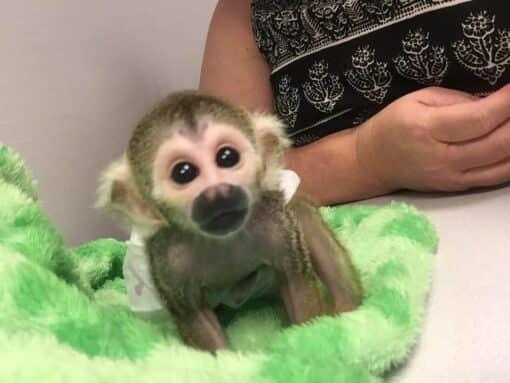
Above ground the rules change. Spider monkeys are the fastest long-distance travellers in the New World canopy, using long arms, a prehensile tail and a hooked hand without a functional thumb to swing hand over hand between supports. Squirrel monkeys and capuchins cover ground in short bursts of leaps, and several guenons can cross gaps of several metres by launching from a springy branch and landing in foliage that absorbs the impact. Colobus monkeys drop deliberately from high branches into lower crowns, using the canopy as a net. The anatomy behind all of this is described in arboreal monkeys and why monkeys have tails.
Why Agility Usually Beats Speed
For most monkeys, escaping a leopard or an eagle is a matter of two seconds of unpredictable movement, not a sustained sprint. A monkey that knows every branch in its home range can vanish into a familiar route faster than a heavier predator can follow, which is why familiarity with terrain is a survival trait in itself. Movement decisions are made constantly and mostly correctly, a form of intelligence discussed in monkey intelligence and how monkeys protect themselves.
Daily Distance, Not Top Speed
The more useful measure for most species is how far they travel in a day. Baboon troops can cover several kilometres, spider monkeys travel long distances between scattered fruit trees, and small folivores may move only a few hundred metres because leaves are everywhere and energy is scarce. Ranging patterns and their causes are set out in monkey migration and movement patterns and monkey diet by species.
Speed and Captive Space
A monkey that evolved to travel a kilometre a day cannot express normal movement in a small enclosure, and the result is obesity, muscle loss and repetitive pacing. Horizontal distance, elevated routes, springy branches and varied surfaces matter more than floor area alone. See how much exercise a monkey needs and the enclosure guide.
Frequently Asked Questions
What is the fastest monkey?
The patas monkey, with reported bursts of about 55 kilometres an hour, the fastest of any primate on the ground.
How fast can a baboon run?
Fast enough to escape most short pursuits, though noticeably slower than a patas monkey because of their greater weight.
Which monkey is the best jumper?
Several are exceptional. Spider monkeys and some guenons cross gaps of many metres, and colobus monkeys make long controlled drops between canopy levels.
Can a human outrun a monkey?
Over a long distance, often yes, since humans are unusually good endurance runners. Over the first fifty metres, almost never.
Read next: monkey adaptations and the strongest monkey species.
Explore More
- Homepage
- Shop
- Health Guarantee
- Shipping
- Contact Us
- Is It Legal to Own a Monkey?
- Capuchin Monkeys (Product Category)
- Guenon Monkeys (Product Category)
- Related: Top Monkey Questions Answered
- Related: Weird and Wonderful Monkey Facts
- Related: Incredible Monkey Photos and Stories
- New Article: Monkeys That Live in Deserts
- New Article: Monkey Migration and Movement Patterns
