
Monkey Facts & Species, Primates Care And Tips
Arboreal Monkeys: How Tree-Dwelling Primates Live
Aug
Arboreal means tree-living, and for monkeys it is the ancestral condition. The primate body plan, with grasping hands, mobile shoulders and depth perception, evolved to move safely through a three-dimensional world of branches, and the species that returned to the ground did so later.
The Hardware of Canopy Life
Arboreal monkeys share a recognisable toolkit: hands and feet that wrap around branches, nails rather than claws for a broad tactile fingertip, long tails for balance, powerful hindlimbs for leaping and forward-facing eyes that judge distance precisely. Spider, howler and woolly monkeys add a prehensile tail with a bare gripping pad, effectively a fifth limb, described further in monkey adaptations.
Ways of Moving
- Quadrupedal branch walking – the default for capuchins, macaques and guenons, running along the tops of branches.
- Suspension – spider monkeys hang and swing below branches, using the tail as an anchor.
- Leaping – squirrel monkeys and tamarins cross gaps in explosive jumps and absorb the landing with the hindlimbs.
- Vertical clinging – marmosets grip trunks with claw-like nails while gouging bark for gum.

Dividing the Vertical Space
Because a forest is layered, several species can share it without competing directly. Large species dominate the strong inner branches and emergent crowns; small species exploit the thin outer twigs that will not carry a predator’s weight; understorey specialists work the shaded saplings. This partitioning is set out in monkey habitats explained and rainforest monkeys.
Safety in the Trees
Height is a defence in itself, and sleeping sites are chosen for it: fine terminal branches, isolated crowns and, for some species, cliffs. Falls do happen, and healed fractures show up regularly in wild primate skeletons, which is a reminder that canopy life carries real physical risk. See monkey predators.
Semi-Terrestrial Exceptions
Baboons, mandrills, geladas, patas monkeys and many macaques spend much of the day on the ground, and their bodies reflect it: longer limbs, more robust builds, and reliance on troop size rather than height for safety. The contrast between the two lifestyles is one of the clearest differences between the families described in Old World versus New World monkeys.
What This Means for Enclosure Design
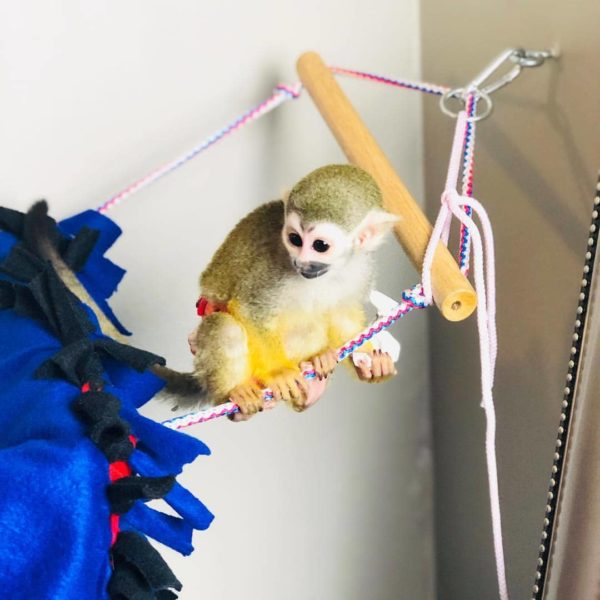
For an arboreal species, vertical space is not decoration, it is habitat. Height matters more than floor area, branches should vary in diameter and springiness, ropes and platforms should create multiple routes between any two points, and elevated refuges let a nervous animal retreat upward as instinct demands. Practical guidance is in our enclosure guide, alongside exercise requirements and enrichment ideas.
Frequently Asked Questions
What does arboreal mean?
Tree-living. An arboreal monkey feeds, sleeps, travels and breeds in the canopy and comes to the ground rarely or never.
Which monkeys are the best climbers?
Spider monkeys are the most specialised, using a prehensile tail and hook-like hands to hang and swing beneath branches with great efficiency.
Are any monkeys not arboreal?
Baboons, geladas, patas monkeys and many macaques are semi-terrestrial, spending much of the day on the ground while still sleeping in trees or on cliffs.
What does this mean for enclosure design?
Height matters more than floor area. Varied branch diameters, multiple routes between points and elevated refuges are all essential for an arboreal species.
Continue with where do monkeys live, nocturnal monkeys and types of monkeys.
Further reading
Explore More

Pingback: Monkey Diet by Species: What Each Monkey Really Eats - Universal Primates
Pingback: How to Build the Perfect Monkey Enclosure - Universal Primates
Pingback: 7 Facts About Where Monkeys Live Worldwide - Universal Primates